You did your time with breakouts as a teenager. So why are you suddenly dealing with acne again at 35, 42 or even later? The answer isn't always as obvious as you might think. Hormonal changes can play a role, but they're only part of the adult-acne story. Stress, medications, skincare and hair products, and other factors may influence what you're seeing. But there's another part of the conversation we don't think gets enough attention:
Adult acne isn't happening in teenage skin.
At 16, you may have been worried about one thing: getting rid of the breakout.
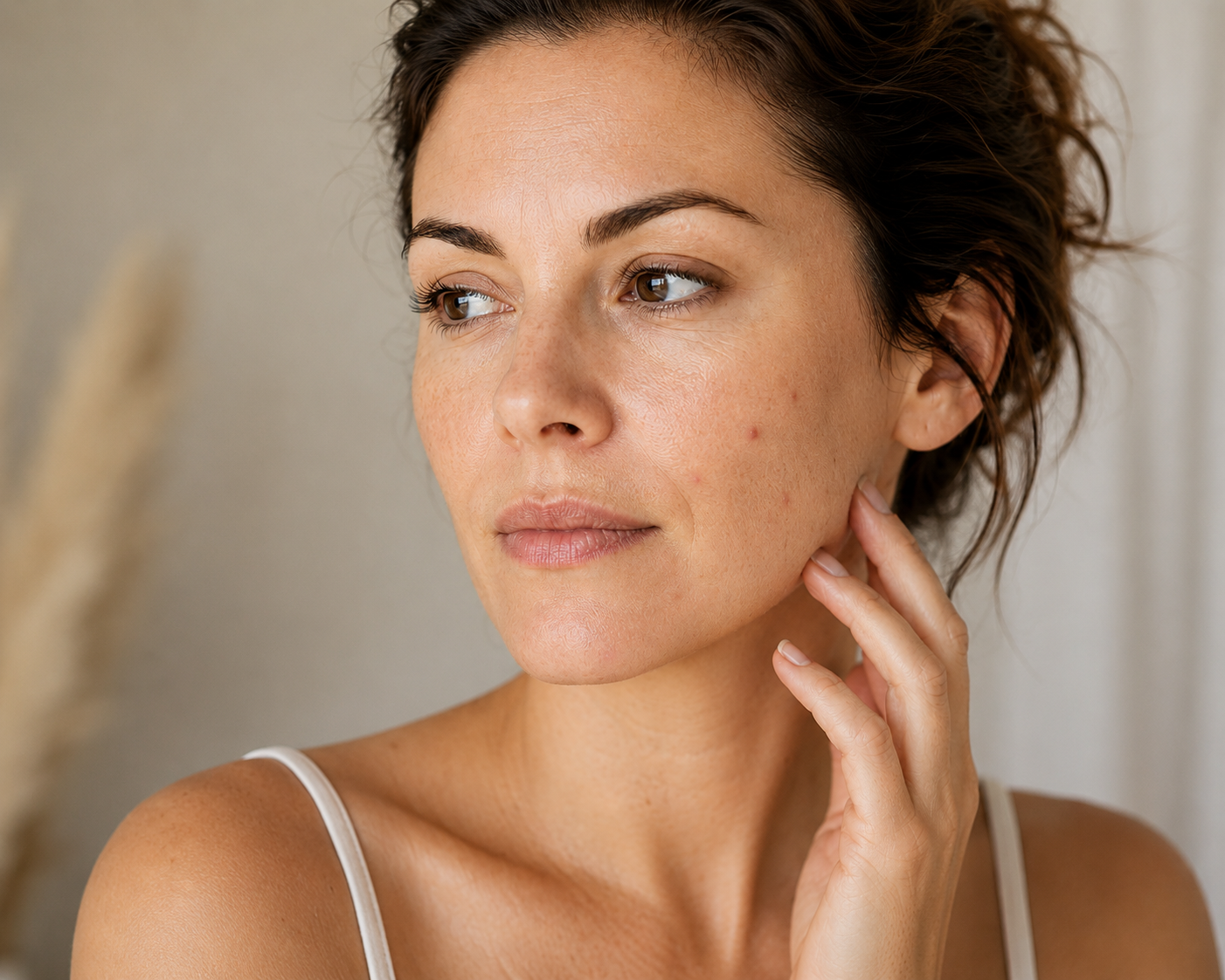
At 40, that same breakout may be happening alongside dehydration, sensitivity, pigmentation from previous blemishes, changes in texture, fine lines, or a skin barrier that's already irritated from everything you've been using to try to clear your skin. That's why adult acne deserves a different approach.
Your Skin Doesn't Have to Pick a Lane
Are you oily or dry? Acne-prone or aging? Sensitive or congested? Real skin doesn't always fit neatly into one category.
You can have an oily T-zone and dehydrated cheeks. You can experience recurring breakouts while also noticing fine lines. You can have clogged pores but be too sensitive for an aggressive exfoliation routine.
Yet many acne routines still focus almost entirely on eliminating oil and drying out blemishes. That's where adult acne care can go wrong.
Are You Treating Your Acne or Irritating Your Skin?
A pimple appears, so you add a spot treatment. Then an acid. Then another acne serum. Maybe you cleanse a little more aggressively and skip moisturizer because you're worried about clogging your pores. Soon, your face feels tight, flaky, sensitive, or irritated and you're somehow still breaking out.
Evidence-based acne ingredients absolutely have their place. But the right ingredient used too aggressively or combined with too many other actives can still create problems.
Sometimes the question isn't:
“What else can I put on this?”
It's:
“Am I actually helping my skin anymore?”
Is It Really Hormonal Acne?
Hormonal fluctuations can contribute to adult acne, particularly during different stages of a woman's life.
But we've also watched “jawline acne = hormonal acne” become almost a diagnosis on social media.
It isn't. Where you're breaking out can provide useful information, but location alone can't tell us why you're breaking out.
If your acne appears suddenly, becomes severe, produces deep or painful lesions, or occurs alongside other unexplained changes, that's a conversation to have with an appropriate medical provider not something to diagnose from a face map online. Before assuming you know the cause, there's another surprisingly useful question:
What changed?
New medication? Birth control change? Perimenopause? New moisturizer? Hair product? Makeup? Facial oil? Increased stress? A completely new skincare routine? Sometimes there isn't an obvious answer. But looking backward before buying forward can keep you from adding another product to a problem you haven't identified yet.
The BE Adult Acne Check-In
Before you add another acne, product or book whatever treatment is trending this week, check these five things.
Is it actually active acne?
A blemish can disappear while leaving behind a red, pink, brown, or darker mark. That mark isn't necessarily active acne, and it isn't automatically an acne scar. If you're still treating an old mark like an active pimple, you may be treating the wrong problem. If blackheads and clogged pores are what you're actually seeing, start with our guide to What's Causing Your Blackheads and How to Treat Them.
Is your skin telling you to back off?
Burning, persistent tightness, unusual sensitivity, flaking, or products suddenly stinging can be clues that it's time to reassess your routine. Acne-prone skin still needs barrier support. Ingredients such as niacinamide can have a place here. Our KYVTA 10% Niacinamide + 1% Zinc PCA Serum, for example, may be incorporated when appropriate for the person's skin and current routine. But the answer isn't that everyone with acne needs niacinamide. The bigger lesson is supporting the skin around the breakout too.
What's happening around the breakout?
Zoom out.
Is the rest of your skin dehydrated? Congested? Sensitive? Oily? Dry? Red? Are previous blemishes leaving discoloration? Are you also concerned about texture or fine lines?
At BE, we're not interested only in what's happening on one square inch of your chin. We want to understand the whole skin environment.
What are you already using?
Before adding something, inventory what you already have. Cleanser. Toner. Serums. Retinoids. Exfoliants. Spot treatments. Moisturizer. SPF. Makeup. Even hair products. Sometimes people realize they're using several acne-focused or exfoliating products without knowing it. Sometimes a better routine requires adding something. Sometimes it requires taking something away.
The Breakout Is Gone. What Now?
This is where adult acne and skin longevity start to intersect. Once active acne is controlled, some people are left with discoloration. Others have changes in texture. Some have both. And jumping straight to an “acne scar treatment” can be a mistake. A flat area of discoloration isn't the same as a true textural scar. Identifying what acne actually left behind comes before choosing how to address it.
Depending on the concern and the individual, professional options at BE may include custom facials, chemical peels, LED light therapy, IPL/photofacials, ClearLift laser rejuvenation, or microchanneling.
There isn't one universal “best acne treatment.”
The right treatment depends on what we're actually treating.
Think Beyond the Next Pimple
This is where our approach to adult acne changes. We're not only asking:
“How do we get rid of this breakout?”
We're also asking: Are you repeatedly irritating your skin trying to clear it? Are you picking and increasing the likelihood of marks? Are you skipping SPF because you're worried it will cause another breakout? Are you treating leftover discoloration as though it's still acne? And are you protecting the health of the skin surrounding all of it? Acne care and skin longevity don't have to compete.
Our KYVTA Clear Defense SPF 45 is one option formulated for oily, acne-prone and combination skin, and we carry additional professional home-care options through the BE VIP App. But your routine doesn't need to contain everything.
Every product should have a reason for being there. At 16, the goal may have simply been getting rid of the pimple. At 40, we can think bigger:
Calm the breakout. Protect the skin around it. Reduce what it leaves behind. And support the health of the skin you're going to live in.
When It's Time for More Than Skincare
Deep, painful, cystic, nodular, persistent, or scarring acne deserves evaluation by a board-certified dermatologist or another appropriate medical provider.
The same applies to significant sudden-onset acne or breakouts occurring alongside other unexplained symptoms.
Sometimes prescription treatment is what's needed. Knowing when not to recommend another facial or product is part of responsible skincare too.
Adult Acne Consultations in Oakhurst, NJ
If you're dealing with adult breakouts and aren't sure whether the issue is acne, congestion, irritation, post-acne marks—or simply a routine that's no longer working for your skin, sometimes the smartest next step is to stop guessing.
At BE Mind Body Skin in Oakhurst, New Jersey, we work with clients throughout Ocean Township, Asbury Park, Long Branch, Deal, Red Bank, Monmouth County, and the Jersey Shore to look at the bigger picture of their skin.
Bring us your products. Tell us what you've tried. Tell us what's changed.
You can schedule a skin consultation, explore the KYVTA skincare collection, or shop additional professional skincare through the BE VIP App.
Because adult acne isn't happening in teenage skin.
It's time we stopped treating it like it is.
This article is for educational purposes only and is not intended to diagnose or treat acne or any medical condition. Persistent, severe, painful, sudden-onset, or scarring acne should be evaluated by an appropriate healthcare professional.